
End
The End node defines the termination point of a Flow.
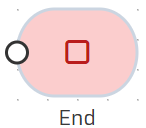
It finalizes Flow execution, performs persistent data saving, and defines the response returned to the Flow caller.
A Flow may contain one or multiple End nodes, typically used to represent different execution outcomes (e.g. success, failure, alternative branches).
Execution Behavior
During execution, the End node:
finalizes the Flow execution
persists all pending Create and Update operations to the database
evaluates and prepares output variables
returns the response to the calling system
Once an End node is reached, no further nodes are executed.
Data Persistence
All Create and Update nodes operate in memory during Flow execution.
Actual persistence to the database occurs only when an End node is executed.
This design ensures:
transactional consistency
predictable rollback behavior
safe Flow experimentation and debugging
If the Flow reaches an End node successfully, all accumulated changes are committed.
Output Variables
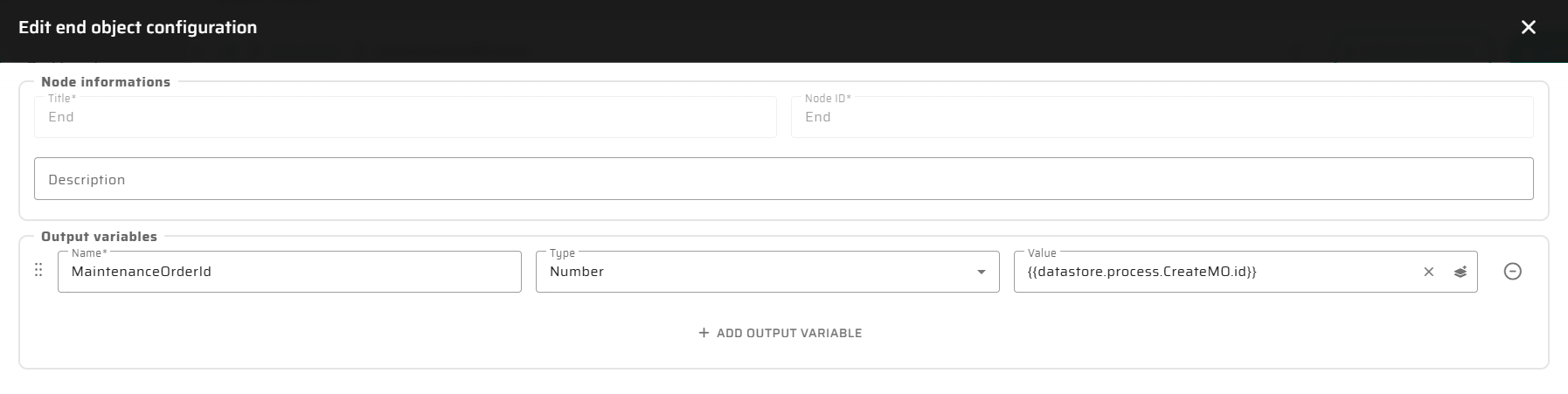
The End node can define output variables that are returned to the Flow caller.
Each output variable has:
a name
a defined data type
a value definition
Output variables form the external response contract of the Flow.
Output Value Definition
Output values can be defined using the same mechanisms as other nodes:
Static Values
Fixed values defined directly.
Typical use cases:
status codes
result flags
constant response values
DataStore References
Values can be referenced directly from the DataStore, such as:
input variables
loaded objects
created or updated entities
calculated variables
This allows returning process results without duplication.
Expression Language Values
Output values can be defined using Expression Language.
Expressions allow:
transforming internal data into API-friendly output
formatting values
conditional response construction
aggregating multiple values
Expressions are evaluated at runtime against the final DataStore state.
For syntax rules, functions, and type compatibility, see Expression Language (Low-Code Syntax).
Expression Evaluation Context
Expressions in the End node:
are evaluated after all process logic is completed
operate on the final state of the DataStore
must resolve to values compatible with declared output types
do not modify process state
This makes the End node ideal for response shaping, not business logic.
Multiple End Nodes
A Flow can contain multiple End nodes.
This is commonly used to:
represent different outcomes (e.g. success vs. error)
return different response structures
separate logical execution branches
Each End node defines its own output configuration.
Typical Usage
The End node is typically used to:
commit Create and Update operations
return created or updated entity identifiers
expose calculated results
signal process completion to the caller
In most Flows, the End node represents the boundary between internal process execution and external system interaction.
Interaction with Expression Language
While the End node does not control Flow logic, it is a key integration point for Expression Language when:
shaping responses
converting internal data structures
applying final formatting or calculations
Expressions in the End node should remain focused on presentation and output, not decision making.
Notes and Limitations
At least one End node is required for a valid Flow
Once an End node is reached, execution stops
Data persistence occurs only at End node execution
Complex business logic should not be placed in End node expressions
Output types must match declared variable types or be convertible